
 Digitnomics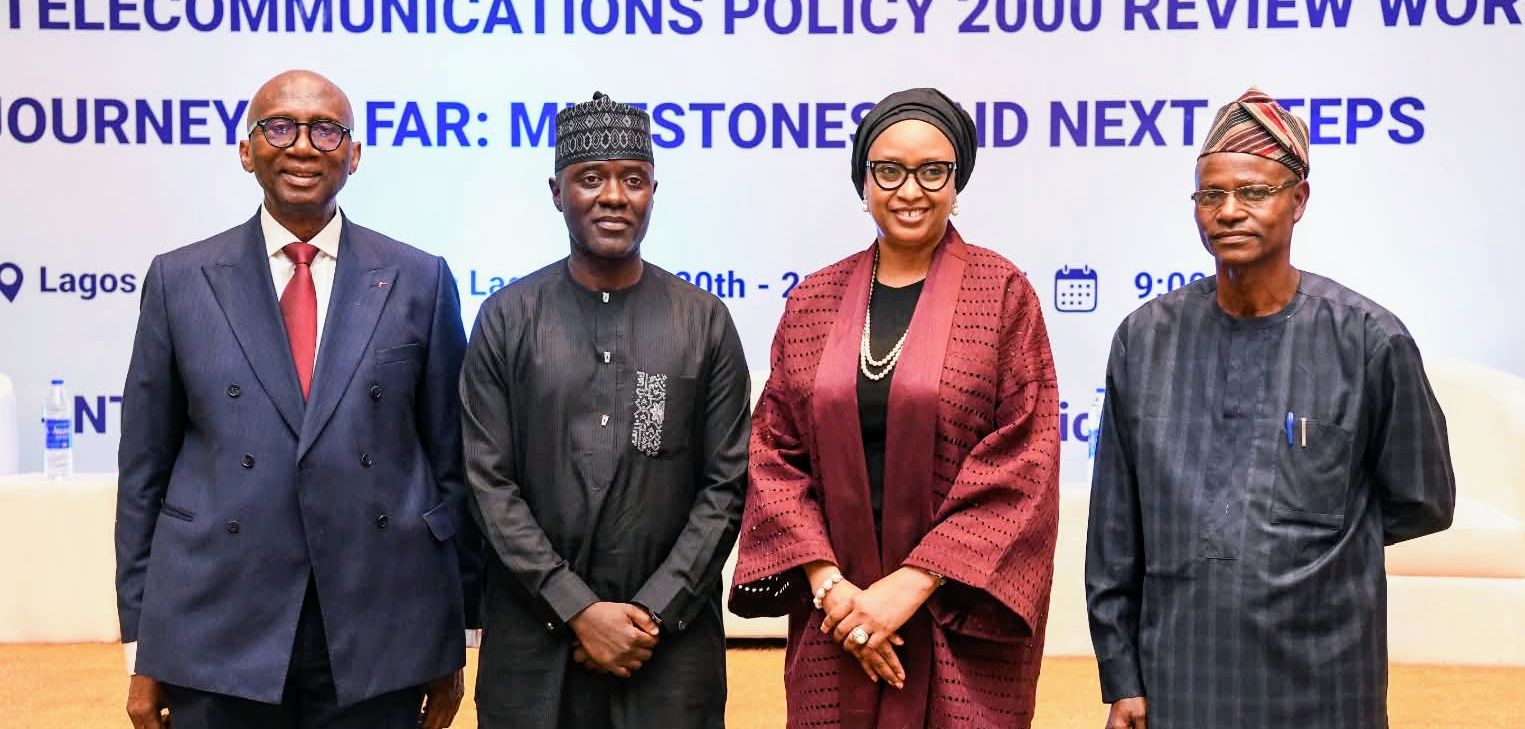
By Francisca Anuforo,
Nigeria is set for its most significant telecommunications policy overhaul in more than two decades as the government moves to replace the National Telecommunications Policy 2000 with a new framework designed to power the country’s digital economy ambitions.
The proposed reform, unveiled at a high-level policy workshop organised by the Nigerian Communications Commission (NCC) in Lagos, is expected to unlock an estimated N1.6 trillion in additional tax revenue and create nearly two million jobs, while repositioning telecommunications as core economic infrastructure rather than a standalone industry.
The review comes amid growing concern that Nigeria’s current telecom policy, developed at the dawn of sector liberalisation, no longer reflects the realities of an economy increasingly driven by broadband, digital platforms, cloud infrastructure, artificial intelligence and next-generation connectivity.
Government officials, regulators, operators and development partners at the workshop agreed that Nigeria’s digital future cannot continue to rely on a 26-year-old policy framework.
Presidency pushes digital-era reset
Delivering the keynote address, Hadiza Bala Usman, Special Adviser to President Bola Tinubu on Policy and Coordination, said the review signals a strategic reset rather than a routine update.
According to her, the telecommunications sector has evolved far beyond its original focus on voice services and now underpins critical sectors ranging from finance and healthcare to education and governance.
“The National Telecommunications Policy 2000 was developed at a defining moment in Nigeria’s reform journey. It supported liberalisation, attracted investment and transformed telecommunications into one of Nigeria’s most dynamic economic sectors,” she said.
However, she stressed that the environment in which the policy was conceived has changed fundamentally.
“More than two decades later, Nigeria has changed. Technology has changed. The economy has changed. The expectations of citizens have changed,” Usman stated.
She argued that the next telecommunications framework must be designed as a national development tool capable of accelerating digital governance, innovation and economic competitiveness.
“A policy is not merely a document. It is the expression of a country’s priorities and the basis through which government choices become measurable outcomes,” she said.
Usman warned that outdated or poorly coordinated policies often result in duplication, weak execution and limited impact.
She identified broadband expansion, digital affordability, cybersecurity, innovation, infrastructure protection, consumer rights and digital inclusion as central priorities for the new framework.
According to her, the policy review aligns directly with President Bola Tinubu’s Renewed Hope Agenda and the administration’s Eight Presidential Priorities.
“The telecommunications policy review should not be approached only as a sectoral obligation. It should be understood as a national development assignment,” she added.
Telecom infrastructure under pressure
The review is taking place against the backdrop of mounting operational challenges confronting the telecom sector.
Industry stakeholders highlighted persistent threats including fibre vandalism, theft, multiple taxation, right-of-way bottlenecks, delayed approvals, insecurity and rising energy costs.
Usman said these problems extend beyond operators and increasingly threaten the broader economy.

“Fibre cuts, vandalism, theft, multiple taxation, right-of-way bottlenecks, delayed approvals, energy constraints and insecurity do not affect operators alone. They affect businesses, schools, hospitals, financial systems and public institutions,” she warned.
She called for stronger collaboration among regulators, operators, state governments, investors and security agencies, stressing that telecom facilities must now be treated as critical national infrastructure.
NCC eyes future-ready telecom framework
Earlier, Executive Vice Chairman and Chief Executive Officer of the NCC, Dr. Aminu Maida, reflected on the transformation of the industry since the policy’s introduction in 2000.
Before liberalisation, he noted, the sector was dominated by NITEL and served fewer than 500,000 active lines for a population exceeding 120 million.
“The policy served its time well. It helped open the market, attract private investment and establish stronger independent regulation,” Maida said.
Since then, the sector has evolved into an infrastructure-intensive ecosystem focused on broadband deployment, spectrum planning, fibre expansion and universal access.
Yet, Maida acknowledged that structural barriers continue to slow digital progress.
“These are not merely operational challenges for operators. They are national development issues because they affect the resilience and reach of digital services,” he said.
According to him, Nigeria has entered a new regulatory era shaped by technologies such as 5G, artificial intelligence, satellite broadband, cloud infrastructure, the Internet of Things and cybersecurity.
“This is no longer a narrow telecommunications conversation. Telecommunications is no longer just one sector within the economy; it is productivity infrastructure for the entire economy,” Maida declared.
Maida cited industry projections indicating that stronger digital integration could substantially expand Nigeria’s economic capacity.
According to a GSMA projection referenced at the workshop, deeper digitalisation could add two percentage points to Nigeria’s GDP by 2028, while generating close to two million jobs and N1.6 trillion in additional tax revenue.
“The policy choices we make today will determine Nigeria’s ability to broaden its tax base, improve public services, create jobs and build a more inclusive economy,” he said.
Maida explained that the workshop was designed to evaluate the implementation of the National Telecommunications Policy 2000, identify regulatory gaps and develop recommendations for a future-ready National Telecommunications Policy 2026.
Also speaking, Ayuba Shuaibu, Director of Policy, Competition and Economic Analysis at the NCC, said the exercise offers stakeholders an opportunity to redefine the future of communications regulation.
“The National Telecommunications Policy 2000 laid the foundation for liberalisation, investment and innovation. But the sector has evolved significantly,” he said.
He noted that emerging realities such as technological convergence, cybersecurity, data governance and collaborative regulation now demand a more forward-looking policy architecture.
Recommendations emerging from the workshop are expected to shape Nigeria’s next-generation telecommunications policy as authorities seek to accelerate digital transformation and strengthen the country’s ambition to emerge as a leading digital economy in Africa.