
CAPPA Report Warns of Rising Youth Exposure to Emerging Nicotine Products Through Digital Platforms
 Digitnomics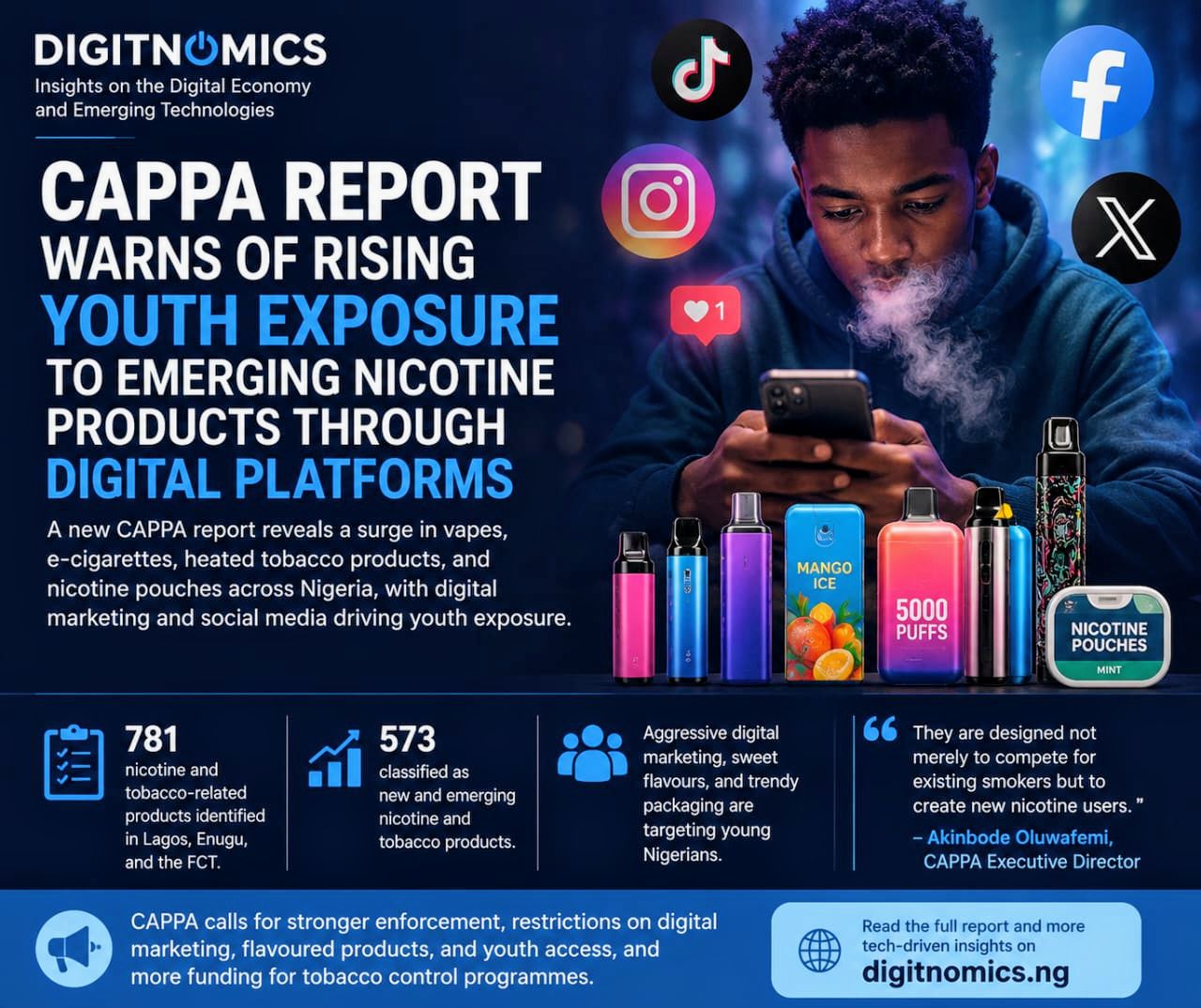
By Francisca Anuforo,
As Nigeria’s digital economy expands and social media becomes a dominant influence on youth culture, health advocates are warning that a new generation of nicotine products is finding fertile ground online.
Corporate Accountability and Public Participation Africa (CAPPA) has raised concerns over the growing presence of vapes, electronic cigarettes, heated tobacco products, and nicotine pouches across digital platforms, warning that aggressive online marketing is accelerating youth exposure and addiction risks.
The organisation, marking the 2026 World No Tobacco Day, said Nigeria is facing a rapidly evolving nicotine challenge driven not only by physical retail outlets but increasingly by digital channels where young people spend significant portions of their time.
According to CAPPA, tobacco companies have shifted strategies from traditional cigarette promotion to modern products packaged as cleaner, safer, and more socially acceptable alternatives.
Its latest report, “New Smoke Trap: New and Emerging Nicotine and Tobacco Products, Youth Exposure and Policy Gaps in Nigeria,” identified 781 nicotine and tobacco-related products during surveillance exercises conducted in Lagos, Enugu, and the Federal Capital Territory. Of these, 573 were classified as new and emerging nicotine and tobacco products.
The report found that many of these products are marketed through colourful branding, attractive packaging, sweet flavours, and digital campaigns designed to appeal to younger audiences.
CAPPA Executive Director, Akinbode Oluwafemi, warned that technology and social media have become critical battlegrounds in the fight against nicotine addiction.
“Many of these products are sold in sweet flavours, packaged in bright colours, and promoted through social media channels popular with young people. They are designed not merely to compete for existing smokers but to create new nicotine users,” he said.
The organisation noted that digital marketing often moves faster than regulatory enforcement, enabling nicotine products to gain visibility and social acceptance before authorities can intervene.
According to CAPPA, the challenge is increasingly being fought on smartphones where millions of young Nigerians consume content daily on platforms such as TikTok, Instagram, Facebook, and X.
Beyond digital advertising, the organisation expressed concern over the growing association of tobacco use with success, prestige, influence, and lifestyle culture, particularly through viral social media content and celebrity-driven trends.
CAPPA also pointed to the increasing visibility of cigar smoking at major social and cultural events, warning that repeated exposure to such imagery could normalise tobacco use among young people and create aspirational associations around nicotine products.
The organisation’s concerns align with global efforts by the World Health Organisation (WHO), which has continued to advocate restrictions on flavourings and additives that make nicotine products more attractive to younger users.
While acknowledging recent efforts by Nigerian authorities to include emerging nicotine products within the country’s excise tax framework, CAPPA argued that taxation alone would not address the growing influence of digital promotion.
According to the organisation, products can remain fashionable and widely accepted even when taxed if governments fail to restrict advertising, youth-oriented packaging, flavouring, online promotion, and access by minors.
The group called on the Federal Government, the Federal Ministry of Health and Social Welfare, the National Agency for Food and Drug Administration and Control (NAFDAC), the National Broadcasting Commission, state governments, and other regulators to strengthen enforcement of existing tobacco control laws.
It also urged authorities to consider stronger restrictions on flavoured nicotine products, expand public smoking regulations to cover emerging nicotine devices, intensify monitoring of digital marketing channels, and increase funding for tobacco control programmes.
For public health experts, the warning is clear. The greatest nicotine threat facing Nigeria today may not be the cigarette of the past but a new generation of products marketed through technology, culture, flavours, and social media.
CAPPA warned that unless regulators move as quickly as the technologies and platforms being used to market these products, Nigeria could face a new public health challenge driven not by traditional cigarette advertising but by digital engagement, social media influence, and technology-enabled marketing.


 Chinenye Anuforo