AI is Transforming Online Shopping in Nigeria, But Consumers Still Hesitate at Checkout – Visa Report
 Digitnomics
Artificial intelligence is rapidly becoming a core part of the online shopping experience in Nigeria, with new research from Visa showing that consumers are embracing AI-powered tools for product discovery, price comparisons, and purchase decisions. However, trust remains a significant barrier when it comes to allowing AI to complete transactions autonomously.
According to Visa’s 2026 Stay Secure Study, 88 percent of Nigerian consumers have used AI tools to assist with shopping activities, while an overwhelming 97 percent believe AI-powered technologies are making online shopping faster and easier.
The findings underscore the growing influence of AI across the e-commerce value chain. Nigerian consumers are increasingly relying on AI to check product reviews and ratings (56%), compare prices (54%), and generate gift recommendations (53%).
Despite the convenience, consumers remain cautious about agentic commerce—the emerging model where AI systems can make purchases on behalf of users. Only 34 percent of respondents said they currently trust AI agents to complete checkout processes independently.
AI Seen as a Key Weapon Against Digital Fraud
While consumers may not yet be ready to hand over purchasing decisions to AI, they are increasingly optimistic about its role in combating fraud.
The study found that 76 percent of respondents believe AI has already made scams easier to identify, while 89 percent expect the technology to play a critical role in protecting consumers from fraud in the future.
The findings come at a time when financial institutions, payment providers, and technology companies are investing heavily in AI-driven fraud detection systems as digital transactions continue to grow across emerging markets.
Social Commerce Expands, Alongside Security Risks
The report highlights the rapid rise of social commerce in Nigeria. About 83 percent of consumers surveyed said they have purchased products directly through social media platforms, reflecting the growing convergence of content, community, and commerce.
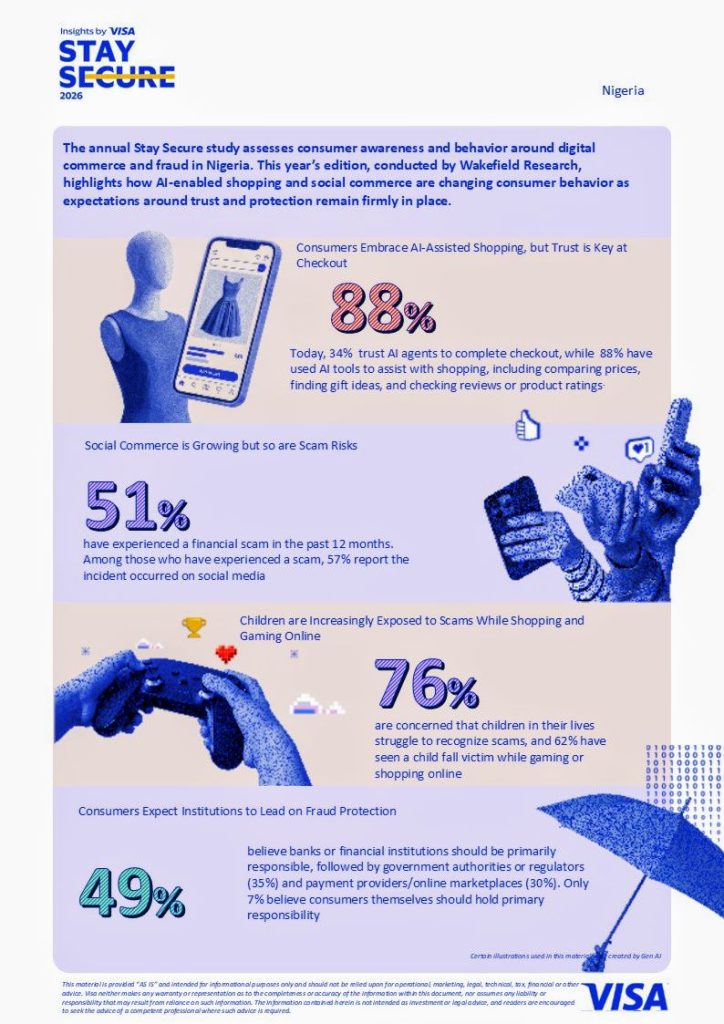
However, the shift toward social commerce is also exposing consumers to higher levels of fraud risk. More than half of respondents (51%) reported experiencing a financial scam within the past year. Among those affected, 57 percent said the incident occurred on social media platforms—higher than reports involving websites, online marketplaces, or dedicated shopping apps.
The data reinforces concerns about security challenges as commerce increasingly migrates to social and mobile-first environments.
Children Emerging as a Vulnerable Digital Demographic
The research also points to growing concerns around online safety for children.
Seventy-six percent of respondents said children in their lives struggle to recognize scams, while 62 percent reported that a child they know had fallen victim to a scam while gaming or shopping online.
As digital payments become more accessible, the exposure of younger users to online financial risks is also increasing. One-third (33%) of Nigerian parents surveyed said their children have access to mobile payment applications or digital wallets.
Consumers Want Institutions to Lead Fraud Protection Efforts
The report suggests that Nigerian consumers view fraud prevention as a shared responsibility but expect institutions to take the lead.
Nearly half of respondents (49%) said banks and financial institutions should bear primary responsibility for protecting consumers from online fraud. Government regulators followed at 35 percent, while 30 percent pointed to payment providers.
Only seven percent believe consumers themselves should be primarily responsible for fraud protection.
Consumers are also looking for more proactive security measures. Sixty-four percent said real-time alerts from banks or payment applications when suspicious activity is detected would increase their confidence in digital payments. Meanwhile, 39 percent said the presence of trusted payment brands at checkout would make them feel more secure.
Commenting on the findings, Irene Auma, Visa’s Head of Risk for the Sub-region, said the future of digital commerce will depend on balancing innovation with trust.
“As commerce moves toward more agentic, AI-powered experiences, consumers are embracing the convenience AI can bring to shopping but remain cautious when it comes to AI completing purchases on their behalf,” she said.
The Stay Secure Study 2026 was commissioned by Visa and conducted by Wakefield Research between January and February 2026. The survey covered 5,800 adults across 17 markets in Central and Eastern Europe, the Middle East, and Africa, including Nigeria.
The findings highlight a critical challenge for the next phase of digital commerce: while AI is becoming deeply embedded in the shopping journey, consumer trust will ultimately determine how quickly autonomous commerce becomes mainstream.