
CBN Signals Major Shift as Stablecoins Take Centre Stage in Payments Vision 2028
 Digitnomics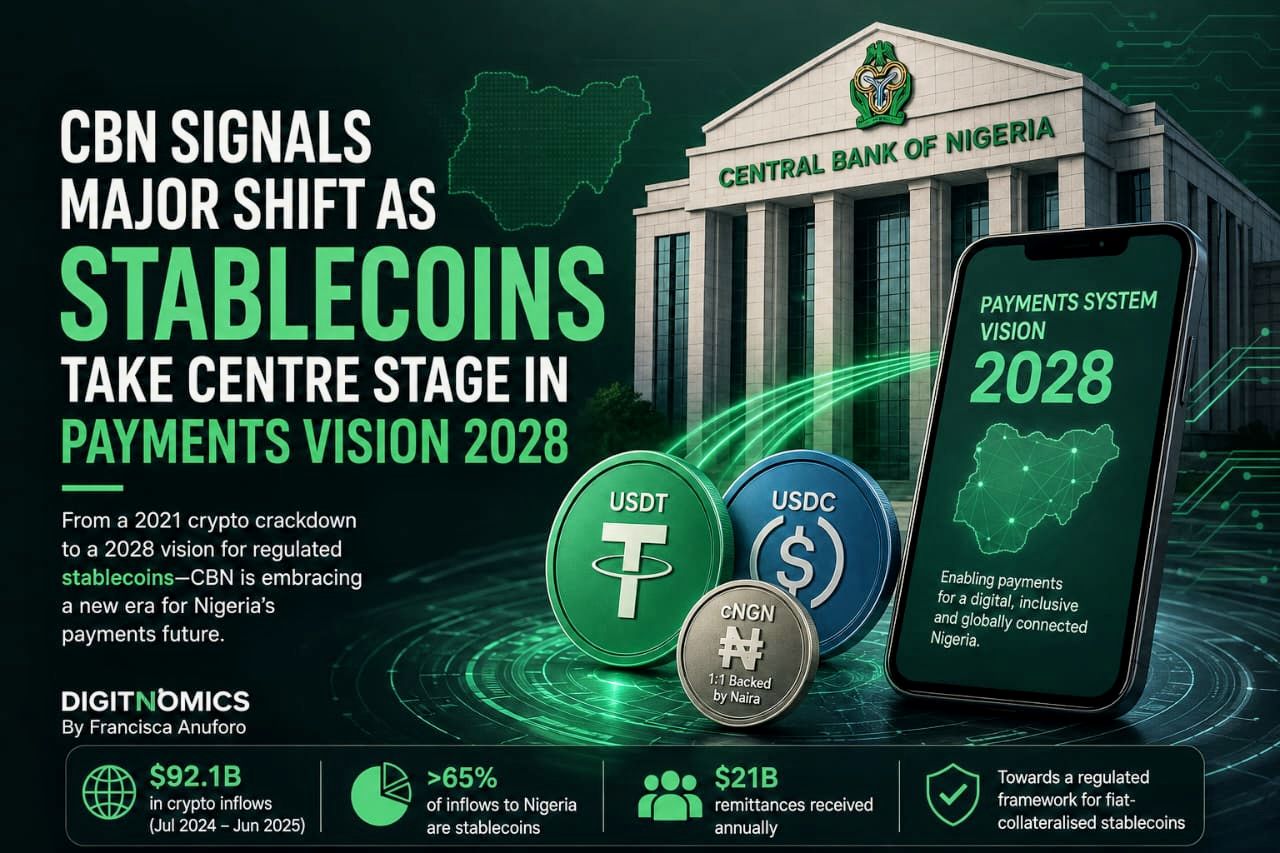
By Francisca Anuforo,
The Central Bank of Nigeria (CBN) is signalling a major policy shift on digital assets, with stablecoins emerging as a key pillar of its newly released Payments System Vision 2028 (PSV 2028).
In a striking departure from its previous stance, the apex bank referenced stablecoins at least 68 times in the document, highlighting their growing relevance to Nigeria’s future payments ecosystem.
The development marks a significant turnaround from February 2021 when the CBN directed banks and other financial institutions to close accounts linked to cryptocurrency transactions over concerns about financial stability, money laundering and consumer protection.
Five years later, the regulator is exploring how stablecoins can be integrated into Nigeria’s regulated financial system to support payments, settlements and cross-border transactions.
Stablecoins are digital currencies designed to maintain a fixed value by being pegged to traditional assets such as fiat currencies. Their stability has increasingly made them attractive for remittances, international trade and treasury management.
According to a recent International Monetary Fund (IMF) report, more than 65 per cent of crypto inflows into Nigeria are now denominated in stablecoins, with Tether’s USDT and Circle’s USDC accounting for the majority of activity.
The IMF also identified Nigeria as the largest recipient of stablecoin inflows in Sub-Saharan Africa, accounting for about 60 per cent of regional inflows between late 2019 and early 2025.
The rise in stablecoin adoption has been linked to periods of high inflation and naira volatility, which encouraged businesses and individuals to seek alternative channels for storing value and conducting international transactions.
Data from blockchain analytics firm Chainalysis showed that Nigeria received approximately $92.1 billion in crypto asset value between July 2024 and June 2025, with stablecoins driving a significant portion of the growth. The country’s crypto transaction volume was nearly three times larger than that of South Africa during the period.
For many Nigerians, stablecoins have become a practical tool for receiving remittances, accessing foreign currency liquidity and making international payments. By operating on blockchain networks, they can help reduce transaction costs and minimise reliance on intermediaries.
Freelancers and remote workers are increasingly using stablecoins to receive payments from overseas clients, while businesses are adopting them for cross-border settlements and treasury operations.
Recognising the growing demand, Nigeria’s first regulated stablecoin, cNGN, was launched in early 2025. The naira-backed digital currency, issued by WrappedCBDC, is pegged one-to-one with the naira. As of June 12, approximately ₦2.3 billion worth of cNGN was reportedly in circulation across 4,805 wallets.
Under its Payments System Vision 2028, the CBN is considering the establishment of a dedicated regulatory framework that would formally recognise fully fiat-collateralised stablecoins as digital monetary instruments.
The proposed framework would require issuers to obtain CBN licences, maintain 100 per cent reserve backing, provide daily attestations, undergo monthly audits and enable real-time regulatory oversight.
According to the apex bank, stablecoins that are fully backed by fiat reserves should be treated differently from traditional crypto assets because they effectively function as digital representations of sovereign currencies.
The regulator is also reviewing supervisory measures for organisations seeking to issue fiat-backed stablecoins within Nigeria’s financial system.
To support the initiative, the CBN plans to pursue legislative amendments that would provide legal recognition for fiat-collateralised stablecoins as monetary instruments rather than securities. The bank also intends to collaborate with the Securities and Exchange Commission (SEC) and other stakeholders to develop a unified policy framework governing their use in payments, settlements and value transfers.
Industry stakeholders believe the move could accelerate blockchain adoption within Nigeria’s financial sector while creating new opportunities for cross-border trade, remittances and digital commerce.
As Nigeria continues to modernise its payments infrastructure, stablecoins are increasingly being positioned as a strategic tool for enhancing financial inclusion and improving the movement of money across borders.