 Digitnomics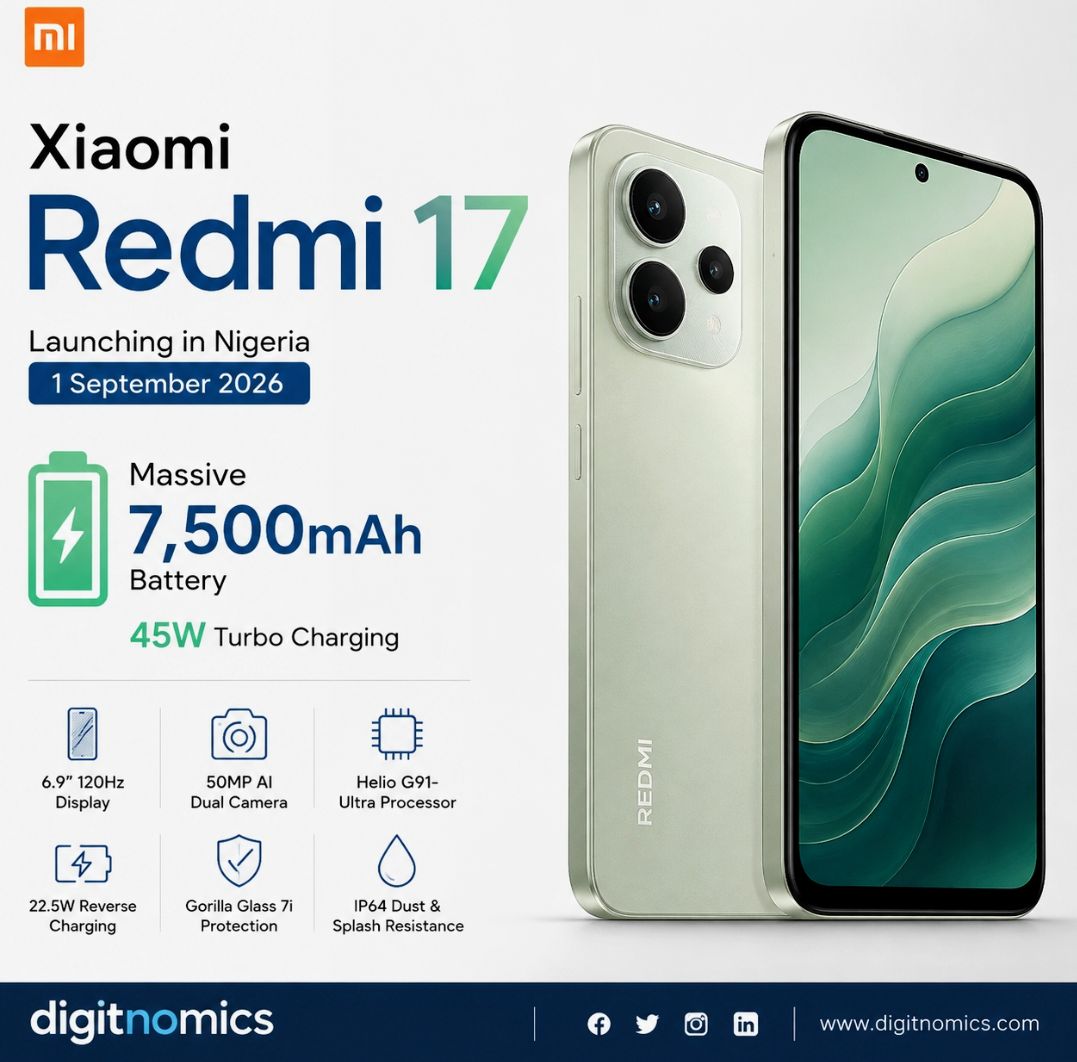
If you are tired of charging your phone several times a day, Xiaomi wants its next Redmi device to get your attention.
Xiaomi is putting battery life at the centre of its strategy for the Nigerian launch of the Redmi 17, with the smartphone coming with a massive 7,500mAh battery and 45W Turbo Charging.
The Redmi 17 is scheduled to launch in Nigeria on September 1, 2026, as Xiaomi looks to strengthen its position in the highly competitive entry-level smartphone market.
For students, young professionals and heavy smartphone users, the company is betting that battery life could be one of the biggest reasons to choose a phone.
The 7,500mAh battery is significantly larger than the 5,000mAh capacity that has become common among smartphones. Xiaomi says the Redmi 17 can deliver up to 91 hours of music playback, while 35 minutes of charging can provide a full day’s use under its stated test conditions.
There is also 22.5W wired reverse charging, meaning the phone can be used to charge compatible devices.
That could make the battery one of the Redmi 17’s biggest selling points in Nigeria, where people often have to manage heavy smartphone use alongside limited access to charging points and unreliable electricity supply.
But Xiaomi is not relying on battery capacity alone.
The Redmi 17 comes with a 6.9-inch display featuring an adaptive refresh rate of up to 120Hz. It is powered by the MediaTek Helio G91-Ultra processor and comes with a 50MP AI dual-camera system.
The smartphone also features dynamic RGB lighting, while Corning Gorilla Glass 7i protection and an IP64 rating provide added protection against dust and splashes.
Beyond the specifications, Xiaomi appears to be making a bigger bet on Nigeria.
The company said during a pre-launch briefing that it expects Redmi 17 shipments in Nigeria to reach six digits over the product’s lifecycle, although it did not disclose an exact target.
Price, however, remains one of the biggest unanswered questions.
Xiaomi has not disclosed the Nigerian price, pointing to rising memory costs and pressure on smartphone production.
The company said it is working with its supply chain to manage the rising costs while maintaining product quality. It also ruled out using second-hand memory components as a cost-cutting measure.
This could be important for the Redmi 17 because Nigeria’s smartphone market remains highly price-sensitive. A strong specification sheet may attract attention, but the final price could determine whether consumers actually buy the device.
For Xiaomi, the calculation is straightforward: give consumers more battery, faster charging and useful features without pushing the phone beyond what its target market can afford.
The Redmi 17 therefore represents more than another smartphone launch.
It shows how battery life is becoming a major battleground in the entry-level smartphone market, particularly as consumers increasingly use their phones for everything from work and online learning to entertainment, banking and communication.
When the Redmi 17 arrives in Nigeria on September 1, the 7,500mAh battery may be its biggest selling point — but the price will likely determine how far that advantage takes Xiaomi.