
 Digitnomics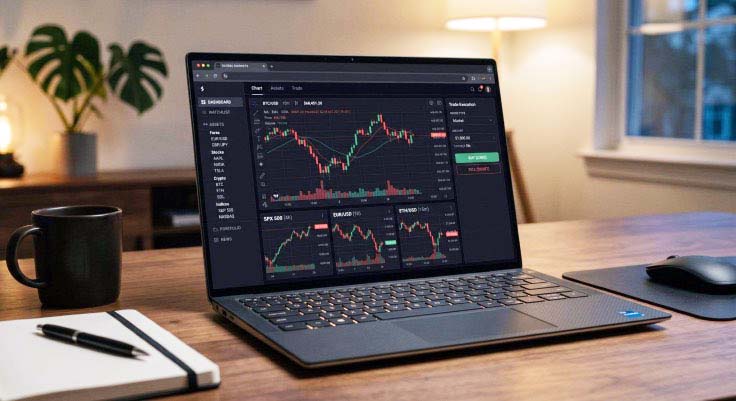
Technology is changing how individuals interact with global financial markets, with browser-based trading platforms emerging as a more flexible alternative to traditional desktop trading software.
A decade ago, accessing many online trading platforms typically meant downloading dedicated applications, installing them on a computer and configuring the software before market activity could begin.
Today, traders can increasingly access market data, charts, account information and trading tools directly through a web browser.
The shift reflects a broader transformation in financial technology, where accessibility, mobility and cross-device compatibility are becoming increasingly important to digital financial services.
Browser-based trading eliminates the need for traders to depend on a single computer or install specialised software before accessing their accounts.
For users who operate across different locations or devices, this can make market monitoring more convenient. A trader can potentially move between computers and continue accessing the same online trading environment, provided there is internet connectivity and the platform supports the device and browser being used.
The development is particularly relevant to the global Contracts for Difference (CFD) market.
CFDs are derivative instruments that enable traders to speculate on price movements of underlying assets without necessarily owning those assets. Depending on the broker and applicable jurisdiction, available instruments may include foreign exchange, commodities, indices, individual stocks and cryptocurrencies.
These markets can react rapidly to macroeconomic data, central bank decisions, corporate earnings, commodity-price movements and geopolitical developments.
Browser-based platforms give traders another route for monitoring such movements and executing orders without waiting for software installation or updates.
But the technology addresses access, not market risk.
CFD trading involves leverage, which can magnify both gains and losses. A more convenient interface does not make the underlying financial product less risky, and users can lose money quickly when markets move against their positions.
The expansion of browser-based trading is also connected to the growing convergence of different financial markets on digital platforms.
Instead of monitoring separate systems for different asset classes, traders can increasingly access multiple markets through a single interface. This can include currency pairs, commodities, equity indices, shares and cryptocurrencies, depending on the platform.
The ability to monitor several markets can also support strategies that consider relationships between asset classes.
For instance, currency movements can be influenced by interest-rate expectations, while commodity prices can affect currencies and companies exposed to particular raw materials. A unified interface can make it easier for traders to observe such movements alongside one another.
Another factor driving adoption is the simplification of everyday trading functions.
While professional traders may require sophisticated analytical and technical tools, many retail users primarily need access to live prices, charts, account balances, market information and order-execution features.
Web terminals can provide these functions without requiring users to maintain dedicated trading software on their computers.
This is part of a larger shift towards multiplatform financial services.
Banks, fintech companies, brokers and other financial-service providers are increasingly designing digital products that can operate across smartphones, computers and web browsers.
The objective is not necessarily to replace desktop applications or mobile trading apps. Rather, browser-based platforms add another access point for users who want flexibility in how they interact with financial services.
For CFD brokers, this multiplatform approach is becoming part of the competition for retail traders.
JustMarkets, for instance, provides access to CFD instruments across different asset classes through multiple trading platforms, including browser-based access.
However, the wider significance of the development extends beyond any individual broker.
Browser-based trading demonstrates how cloud computing, web applications and improved internet infrastructure are gradually removing some of the technical barriers that previously stood between retail users and digital financial markets.
For emerging markets such as Nigeria, where smartphone and internet adoption continue to influence financial-service delivery, the wider trend towards accessible digital platforms could further change how individuals engage with international financial products.
Yet increased accessibility also places greater emphasis on consumer awareness.
Before using CFD platforms, traders need to understand leverage, spreads and other costs, volatility, applicable regulations and the possibility of losing their invested capital.
As financial technology continues to evolve, the browser is becoming more than a tool for accessing information. It is increasingly serving as an interface through which users can interact directly with sophisticated financial markets.
The next phase of digital trading may therefore be less about where trading software is installed and more about how seamlessly financial services can be accessed across the devices people already use.