Nigeria’s Digital Economy Faces Fresh Threat as Telecom Infrastructure Attacks Escalate
 Digitnomics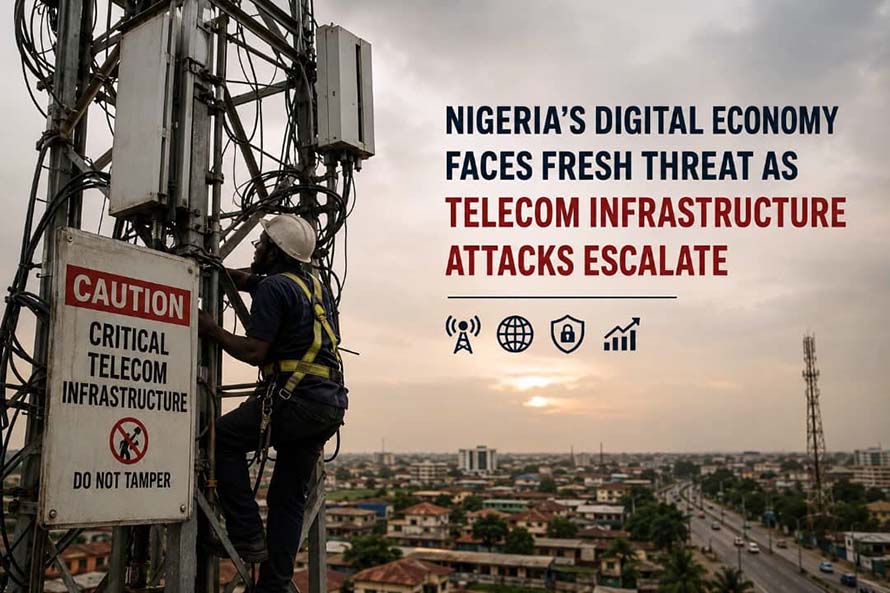
By Francisca Anuforo,
Nigeria’s rapidly expanding digital economy is coming under increasing pressure as rising attacks on telecom infrastructure threaten investments worth trillions of naira and disrupt critical connectivity services nationwide.
Telecom operators are currently investing heavily in broadband expansion, fibre deployment and network upgrades to meet surging demand for internet access, fintech services, digital banking, streaming and cloud-based applications. However, vandalism, fibre cuts, diesel theft and destruction of telecom facilities are emerging as major threats to the sector’s growth.
Industry figures highlight the scale of infrastructure now exposed to attacks. MTN Nigeria reported network infrastructure valued at about N1.64 trillion in its Q1 2026 financial statement, while its total property, plant and equipment stood at N2.11 trillion.
The telecom operator also invested N428.05 billion in acquisition of property and equipment during the first quarter of 2026 alone as it intensified network expansion and upgrades across the country.
Airtel Africa similarly disclosed capital expenditure of approximately $884 million for its 2026 financial year as it accelerated fibre rollout and site expansion across its African operations.
The growing investments underscore the importance of telecom infrastructure to Nigeria’s digital economy. But industry stakeholders warn that the increasing attacks on critical infrastructure could slow progress, inflate operating costs and weaken investor confidence.
According to the Association of Licensed Telecommunications Operators of Nigeria (ALTON), the telecom industry recorded 19,384 fibre cuts between January and August 2025, alongside 3,241 incidents of equipment theft and more than 19,000 denial-of-access cases affecting telecom infrastructure nationwide.
Stakeholders say the attacks are causing major disruptions to mobile connectivity, banking platforms, enterprise services and ATMs because telecom networks are deeply interconnected.
ALTON Chairman, Gbenga Adebayo, disclosed that operators record as many as 40 fibre cuts daily along the Lagos–Kano telecom corridor alone, worsening network congestion and service disruptions nationwide.
“At the end of the day, we have one national network,” he said, explaining that a single fibre cut can affect multiple telecom operators, financial institutions and enterprise systems simultaneously.
The Nigerian Communications Commission (NCC) acknowledged that vandalism has become one of the major structural cost pressures confronting operators.
Executive Vice Chairman of the NCC, Dr Aminu Maida, said the Commission is addressing operational challenges linked to infrastructure vandalism and right-of-way costs while supporting large-scale network expansion projects.
According to him, operators have committed to approximately 12,000 site upgrades in 2026, compared to just over 300 new or upgraded sites deployed last year. About 2,800 upgrades have already been completed.
The upgrades involve deployment of new telecom sites, expansion of network capacity and migration from older 2G and 3G infrastructure to advanced 4G and emerging 5G networks.
However, analysts warn that repeated attacks on telecom assets could undermine the gains from those investments.
The growing dependence on digital services is also increasing the economic consequences of infrastructure disruptions. MTN Nigeria generated N826.07 billion from data revenue in Q1 2026, compared to N528.98 billion in the corresponding period of 2025, reflecting rising reliance on digital connectivity by businesses and consumers.
The operator also disclosed rising network maintenance and security costs. MTN spent N51.66 billion on network maintenance during the period, while security-related expenses increased to N887 million from N621 million recorded a year earlier.
The company further reported impairment losses linked partly to damaged network infrastructure.
Diesel theft remains another major challenge because operators rely heavily on generators to power thousands of telecom sites amid unstable electricity supply nationwide.
Maida noted that the high cost of powering telecom infrastructure with diesel generators remains a major financial burden for operators.
He added that Nigeria’s long-term broadband future would depend heavily on fibre infrastructure because fibre-based broadband offers the most sustainable and cost-effective path for supporting growing demand for video streaming, cloud services and other high-capacity digital applications.
The NCC also admitted that improving user experience remains difficult because rising data consumption often outpaces network expansion efforts.
Industry stakeholders warned that sustained vandalism and infrastructure theft could discourage future investments if operators continue to absorb mounting replacement and maintenance costs.
Adebayo argued that vandalism of telecom infrastructure should be treated with the same seriousness as attacks on oil pipelines because of its growing impact on financial services, security communications and economic activities nationwide.
The challenge is compounded by Nigeria’s dependence on imported telecom equipment sourced largely from manufacturers such as Ericsson and Nokia, making infrastructure replacement increasingly expensive amid foreign exchange volatility.
The NCC disclosed that one major telecom operator alone is investing more than $1 billion this year, surpassing total industry spending recorded in the previous year.
Operators are also struggling with insecurity in some parts of the country.
“We have territories that we cannot access because of issues of security,” Adebayo disclosed.
Beyond physical attacks, industry concerns are expanding to include cyber threats targeting critical digital infrastructure.
The NCC recently unveiled a Cyber Resilience Framework aimed at strengthening collaboration among telecom operators, financial institutions and security agencies to protect digital infrastructure against cyber and physical risks.
Industry players continue to push for stronger protection of telecom assets as Critical National Infrastructure, arguing that attacks on telecom facilities now directly affect banking systems, digital payments, security communications and economic productivity nationwide.
Airtel Nigeria recently disclosed that it recorded more than 50,000 major vandalism incidents within the last five years, highlighting the growing scale of attacks confronting operators.
Analysts also noted that operators such as MTN Nigeria may remain sensitive to broader geopolitical tensions because of their visibility and foreign ownership structures.
With telecom infrastructure investments now running into trillions of naira, experts warn that continued attacks could have far-reaching implications for connectivity, investor confidence and Nigeria’s digital economy ambitions.
Despite the mounting challenges, the NCC insists that reforms, infrastructure expansion and tighter regulatory oversight are gradually improving service quality.
Still, industry stakeholders maintain that protecting telecom infrastructure must become a national priority if Nigeria hopes to sustain broadband growth and fully unlock the opportunities within its digital economy.