
 Digitnomics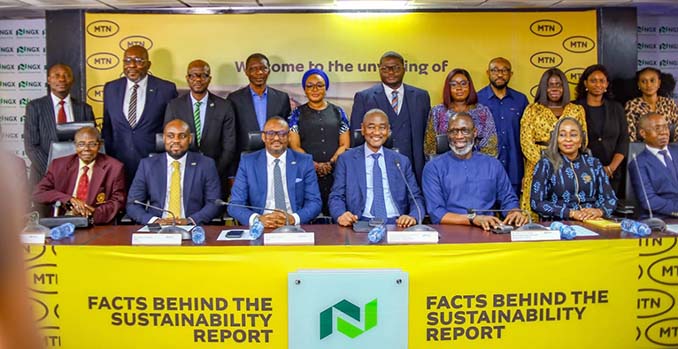
By Francisca Anuforo,
MTN Nigeria contributed NGN878.7 billion in taxes, levies and duties to federal and state governments in the 2025 financial year, reinforcing the growing role of major technology and telecom companies in supporting Nigeria’s non-oil revenue drive.
The figure, disclosed in the company’s 2025 Sustainability Report, represents a 15 per cent increase from the NGN764 billion remitted in 2024 and highlights the telecom giant’s expanding fiscal contribution amid Nigeria’s push to strengthen public revenue and reduce dependence on oil earnings.
The latest remittance comes as MTN Nigeria staged a strong financial recovery, swinging from a NGN399 billion loss to a profit after tax of NGN1.11 trillion in 2025, driven largely by revenue growth and improved operating performance.
The company’s total revenue rose by 54.8 per cent to NGN5.20 trillion, while operating profit climbed sharply to NGN2.08 trillion from NGN778.2 billion recorded in the previous year.
MTN’s tax trajectory reflects both its expanding business operations and its growing importance within Nigeria’s fiscal ecosystem. The company paid NGN543.9 billion in taxes and levies in 2023 before increasing that figure to NGN764 billion in 2024, representing a cumulative rise of approximately 62 per cent over two years.
The NGN878.7 billion remitted in 2025 covered a broad range of statutory obligations, including company income tax, value-added tax (VAT), spectrum fees, import duties, Nigerian Communications Commission (NCC) levies and contributions under the Rural and Urban Terrestrial Infrastructure (RUTI) tax credit framework.
MTN Nigeria said the RUTI scheme forms part of its long-standing public-private partnership approach to infrastructure development.
The company has previously participated in the Federal Government’s Road Infrastructure Tax Credit Scheme, under which it committed NGN202.8 billion toward the reconstruction of the 110-kilometre Enugu-Onitsha Expressway.
According to the report, the RUTI programme reached 50 per cent completion in 2025 after securing approval for an additional NGN23 billion tax credit aimed at expanding fibre and telecommunications infrastructure in underserved communities.

Industry analysts say such tax-credit infrastructure models are becoming increasingly significant as governments seek alternative financing mechanisms to close infrastructure gaps without relying solely on direct public expenditure.
Beyond taxes, MTN Nigeria also expanded its domestic economic footprint during the year.
The report showed that 62 per cent of the company’s procurement spending in 2025 went to Nigerian suppliers, up from 59.6 per cent in 2024, supporting local industries spanning civil construction, logistics, software development and power infrastructure.
The telecom operator’s nationwide infrastructure continued to expand, with 2,087 active base stations supporting its network operations.
By the third quarter of 2025, MTN Nigeria recorded 85.4 million active mobile subscribers and 51.1 million active data users, supported by smartphone penetration of 65.1 per cent.
The company also strengthened its spectrum portfolio during the year, renewing its 800MHz spectrum licence for another ten years through December 2034.
In addition, MTN secured regulatory approval to lease additional spectrum from T2 Mobile, formerly 9Mobile, across 17 states and the Federal Capital Territory, a move expected to enhance network capacity and improve digital connectivity.
Analysts say MTN Nigeria’s rising tax payments and continued infrastructure investments underscore how telecom operators are increasingly evolving beyond connectivity providers into strategic contributors to national revenue generation, digital infrastructure expansion and broader economic development.