
Nigeria’s Smartphone Shipments Rise 8% in Q1 2026 as Demand for 4G, 5G Devices Holds Strong
 Digitnomics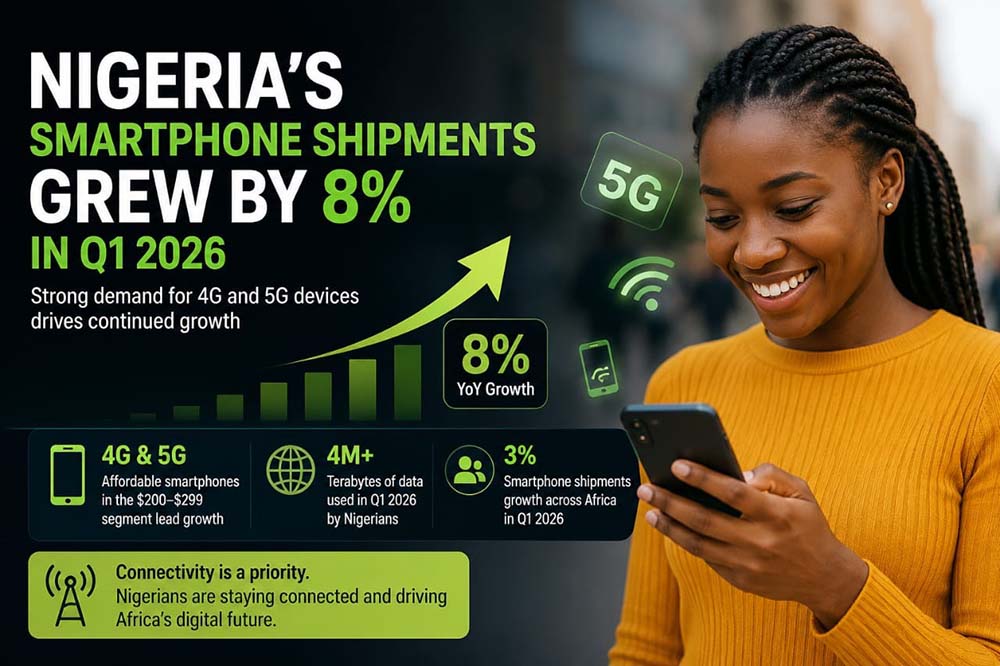
By Francisca Anuforo,
Nigeria’s smartphone market recorded an 8 per cent year-on-year growth in the first quarter of 2026, reflecting sustained consumer demand for internet-enabled devices despite mounting economic pressures and rising data costs.
According to new data released by market intelligence and consultancy firm Omdia, the growth was largely driven by strong demand for affordable 4G and 5G smartphones, particularly devices within the $200–$299 price segment.
The report suggests that connectivity continues to rank high among Nigerian consumers, even as inflation, supply-chain disruptions and affordability concerns persist.
Omdia noted that broader macroeconomic challenges, including semiconductor shortages, potential increases in smartphone prices and geopolitical tensions affecting global supply chains, have not significantly weakened consumer appetite for mobile connectivity.
“Consumers continue to prioritise connectivity despite ongoing economic pressures and rising data costs,” the report stated.
The trend aligns with Nigeria’s growing internet consumption.
Data from the Nigerian Communications Commission (NCC) showed that telecom subscribers consumed more than 1.4 million terabytes of data in March 2026 alone — the highest monthly usage recorded so far.
Combined figures indicate that Nigerians consumed over four million terabytes of data during the first quarter of 2026, underscoring the increasing centrality of online engagement, digital services and social platforms in daily life.
The rising demand for smartphones mirrors broader shifts in digital behaviour, as millions of Nigerians deepen their presence across platforms such as WhatsApp, TikTok, Facebook, Instagram and X.
Africa’s Smartphone Market Maintains Growth Momentum
Across Africa, smartphone shipments rose by 3 per cent year-on-year to 19.9 million units during Q1 2026, supported by new product launches and stronger inventory supply among leading vendors.
Omdia noted that Africa continues to demonstrate structurally strong demand for smartphones, fuelled by expanding digital adoption and growing connectivity needs.
Nigeria and South Africa emerged as key contributors to continental growth.
South Africa recorded a 17 per cent increase in smartphone shipments during the quarter, while Nigeria followed with an 8 per cent rise.
Analysts attribute much of the momentum to Africa’s youthful, mobile-first population.
With roughly 60 per cent of Africa’s population below the age of 25 and nearly 70 per cent under 30, the continent remains one of the world’s fastest-growing digital markets.
An African Union projection estimates that by 2030, young Africans could account for 42 per cent of the global youth population, reinforcing long-term demand for smartphones and digital services.
Rising Costs Challenge Market Expansion
Despite the growth, affordability pressures continue to shape the market.
Omdia warned that worsening economic conditions and operational challenges are making smartphones increasingly difficult to afford for both consumers and vendors.
The report highlighted rising import duties, supply-chain disruptions, geopolitical instability and escalating retail prices as major constraints affecting several African markets.
These challenges contributed to shipment declines in countries including Egypt, where smartphone shipments fell by 10 per cent year-on-year, Kenya, which recorded a 16 per cent decline, and Algeria, which experienced the region’s steepest drop at 28 per cent.
Manish Pravinkumar, Principal Analyst at Omdia, said increasing memory component costs continue to place pricing pressure on smartphone manufacturers.
“Escalating memory input cost continues to build pricing pressure on vendors, while financing-led demand is gradually improving accessibility to higher-priced devices,” he said.
TRANSSION Retains Market Leadership
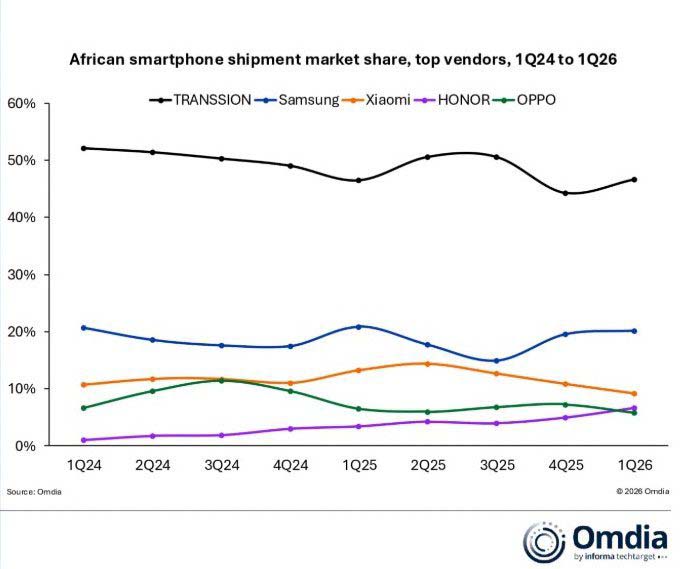
In terms of vendor performance, TRANSSION maintained its dominance across Africa with a 47 per cent market share and 4 per cent growth during the quarter.
The company’s performance was supported by strong demand for affordable smartphone models, including the Tecno Pop 10 and Spark 40C 4G, alongside disciplined inventory management.
Samsung retained second position despite recording a marginal one per cent decline in annual growth.
Its Galaxy A-series continued to perform strongly within the $150–$299 segment, supported by distribution investments in key markets such as Egypt.
Xiaomi ranked third after shipments declined by 28 per cent, largely due to memory supply constraints.
HONOR delivered the fastest growth among leading brands, recording a 101 per cent increase driven by stronger demand in South Africa’s mid-range market and improved financing access.
OPPO rounded out the top five but saw shipments decline by 7 per cent amid restructuring efforts and softer market conditions in Egypt.
Omdia noted that smartphone market performance during the remainder of 2026 will depend heavily on broader economic conditions, vendor adaptability and the pace at which manufacturers address affordability and supply-side pressures.