 Digitnomics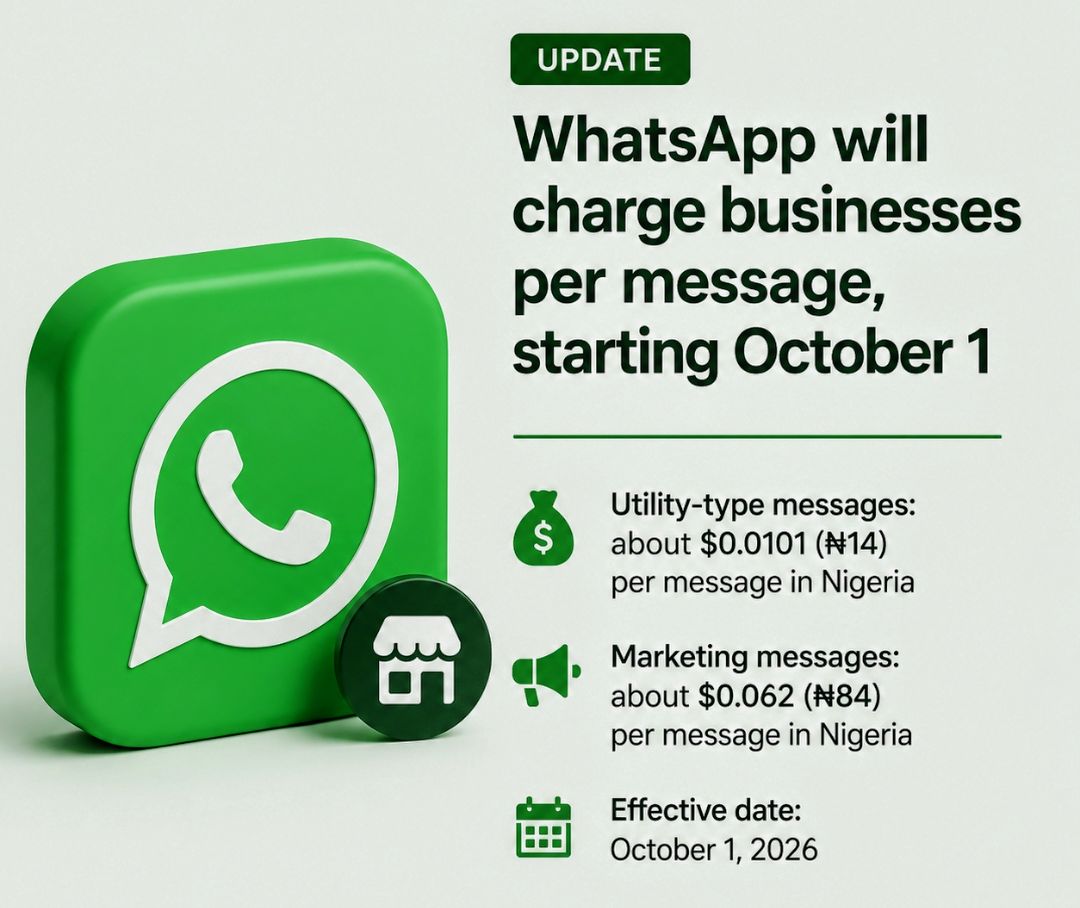
Businesses that rely on WhatsApp to communicate with customers are set to face a new cost from October 1, 2026, as Meta prepares to charge for certain messages sent through the WhatsApp Business Platform.
The change means businesses using WhatsApp at scale could see their communication expenses rise, particularly those sending large volumes of customer-service, notification and marketing messages.
How much will businesses pay?
In Nigeria, chargeable utility-type messages will cost about $0.0101, or roughly ₦14 per delivered message, according to the current rate cited for the platform.
Marketing messages will be significantly more expensive, at about $0.062, or approximately ₦84 per message.
While ₦14 may appear insignificant when looking at a single message, the cost can become substantial when a business sends hundreds of thousands of messages.
For example, a business sending 500,000 chargeable messages at about ₦14 each would face approximately ₦7 million in messaging fees.
And that is before considering any additional fees a business may pay to its software provider or WhatsApp Business Solution Provider.
Who will be affected?
The change is not a general WhatsApp charge.
Ordinary WhatsApp users will not suddenly have to pay to send messages, and businesses using the standard WhatsApp Business app are not the primary target of this change.
The charges apply to businesses using the WhatsApp Business Platform/API, which is designed for companies communicating with customers at scale.
This includes businesses such as banks, fintechs, airlines, retailers, telecommunications companies, e-commerce platforms and other organisations that use automated WhatsApp communication.
For these businesses, WhatsApp has increasingly become more than a messaging application.
It can function as a customer-service desk, sales channel, notification system and even a digital storefront.
WhatsApp has been changing its pricing model
The October change is part of a broader shift in how Meta charges businesses for WhatsApp.
In July 2025, WhatsApp moved away from its previous conversation-based pricing structure towards per-message pricing for certain business-initiated template messages.
However, some customer-service interactions retained free treatment, particularly messages sent within the 24-hour customer-service window after a customer contacted a business.
From October 1, 2026, Meta will extend charges to some of these previously free service interactions.
This means businesses will need to pay much closer attention to how they use WhatsApp for customer communication.
Why this matters for Nigerian businesses
WhatsApp has become a major communication channel for businesses in Nigeria.
A customer may place an order through WhatsApp, receive a payment confirmation, ask a question, receive an update and eventually get a delivery notification — all through the same platform.
When thousands or millions of customers are involved, even a small charge per message can become a significant operating expense.
For startups and small businesses operating on tight margins, the impact could be more noticeable.
Businesses may have to rethink automated messages, reduce unnecessary communication and become more deliberate about which interactions are handled through the WhatsApp Business Platform.
WhatsApp is becoming business infrastructure
The bigger story is not simply that WhatsApp is introducing another fee.
It is that WhatsApp has become deeply embedded in how businesses communicate with African consumers.
Meta is now monetising that commercial activity by charging businesses based on the volume, type and destination of their messages.
The model could become increasingly important as more African businesses move customer service, sales and transactions online.
For businesses operating across several African countries, the cost will also vary because Meta’s rates depend partly on the recipient’s country and the category of message.
What businesses should do
Businesses that depend heavily on WhatsApp should start reviewing their communication processes before the new pricing takes effect.
They may need to identify which messages are chargeable, determine how much they currently spend on WhatsApp-related communication and assess whether some messages can be consolidated or delivered through other channels.
The key lesson is simple: a platform that once felt like a free communication tool can eventually become a significant business expense when your company depends on it at scale.
From October 1, businesses using the WhatsApp Business Platform will need to treat messaging not just as communication, but as another operating cost to manage.