
Inflation pushes Nigerians to online car marketplaces as average vehicle listings approach ₦30 million
 Digitnomics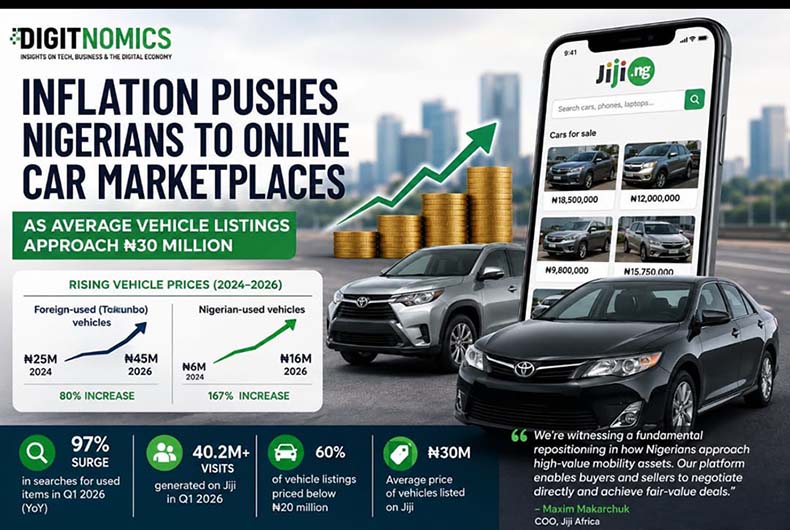
By Francisca Anuforo
Nigeria’s worsening inflation and rising vehicle prices are reshaping how consumers buy cars, with more buyers abandoning traditional dealerships in favour of online marketplaces where they can negotiate directly with vehicle owners.
Fresh market insights released by Jiji, one of Africa’s largest online marketplaces, show that the average value of vehicles listed on its platform has climbed to nearly ₦30 million, reflecting the growing impact of inflation, exchange rate volatility and higher import costs on the country’s automotive sector.
The platform’s analysis of the past two years reveals that average listing prices for foreign-used (Tokunbo) vehicles increased from approximately ₦25 million to ₦45 million, representing an 80 per cent rise. Nigerian-used vehicles also recorded a significant increase, with average prices jumping from about ₦6 million to ₦16 million, a 167 per cent increase.
The figures mirror Nigeria’s broader economic realities. According to the National Bureau of Statistics (NBS), headline inflation stood at 15.91 per cent in June 2026, while transportation costs remained among the fastest-rising components of household expenditure. These factors have continued to weaken purchasing power, making vehicle ownership increasingly difficult for many Nigerians.
Although the Federal Government reduced the National Automotive Council (NAC) levy on imported used vehicles from 15 per cent to five per cent in July 2026, industry players say the relief has been largely offset by exchange rate fluctuations, multiple statutory charges and newly introduced engine-capacity-based green taxes.
Online marketplaces gain momentum
As affordability becomes a major concern, more Nigerians are turning to digital platforms that allow buyers and sellers to transact directly.
Jiji disclosed that searches for used products on its platform surged by 97 per cent year-on-year during the first quarter of 2026, generating more than 40.2 million visits. The vehicles category emerged as one of the biggest contributors to this growth.
The marketplace also reported that around 60 per cent of all vehicle listings are priced below ₦20 million, giving budget-conscious buyers more options despite the challenging market conditions.
Toyota Camry remains the platform’s most popular vehicle, accounting for roughly one in every ten car listings.
Pricing patterns also vary across Lagos, with vehicles listed on the Island averaging almost twice the prices of those on the Mainland, highlighting differences in inventory quality, seller demographics and buyer preferences.
Dealers adapt to changing market realities
Automobile dealers are also adjusting their business models as demand shifts online.
Babatunde K., Managing Director of Apex Motors in Lagos, said the increasing cost of importing replacement inventory has made it difficult to rely solely on physical dealerships.
«”Importing vehicles for display in car lots now comes with enormous costs that many buyers cannot absorb. Listing vehicles on Jiji allows us to connect directly with serious buyers while reducing inventory holding costs and improving sales turnaround.”»
Consumers are also benefiting from direct negotiations.
Abuja-based Senior Financial Analyst, Chinedu E., said purchasing directly from a vehicle owner enabled him to save more than ₦4 million on a 2019 Toyota Camry after comparing dealership prices with listings on the platform.
Digital commerce reshaping Nigeria’s auto market
Commenting on the trend, Jiji Chief Operating Officer, Maxim Makarchuk, described the shift as evidence of a broader transformation in Nigeria’s automotive retail ecosystem.
He said consumers are becoming more price-conscious and increasingly prefer transparent digital platforms where they can negotiate directly with sellers rather than paying dealership mark-ups.
According to him, online marketplaces are becoming essential tools for connecting buyers with realistic market prices while improving access to vehicle ownership during a period of economic uncertainty.
As inflation continues to influence consumer spending, digital marketplaces are expected to play an even greater role in Nigeria’s automotive industry by offering wider inventory, greater price transparency and more flexible purchasing options for individuals and businesses alike.