South Africa’s Digital Voter Registration Raises Questions About What Nigeria Can Learn
 Digitnomics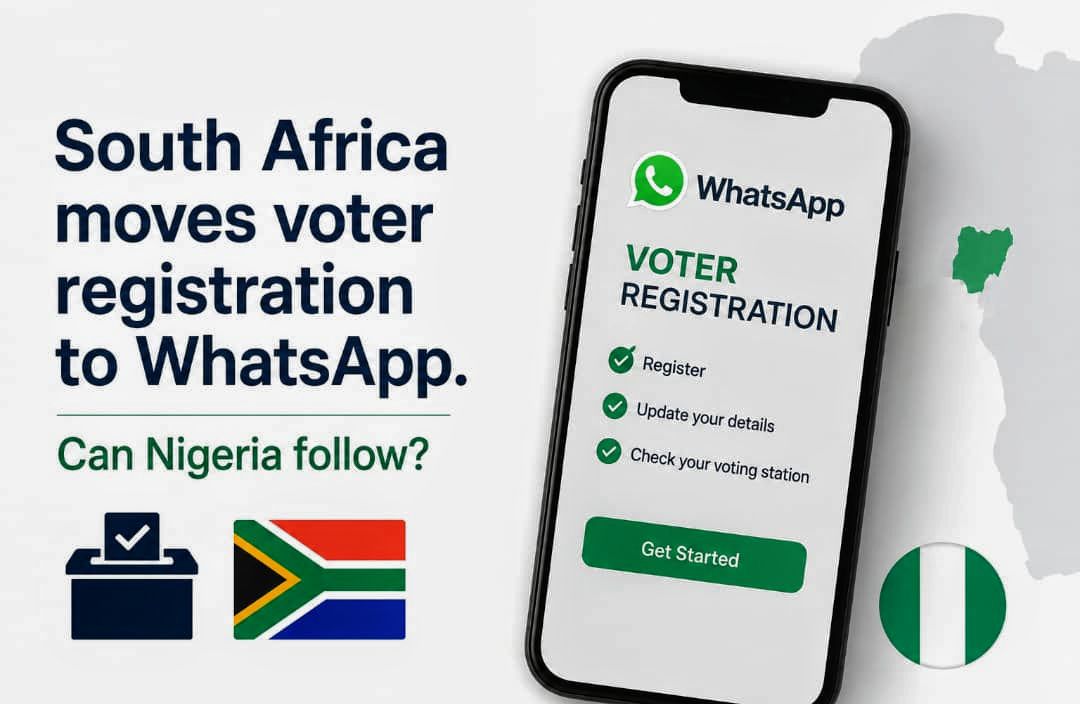
South Africa is taking another step towards making voter registration more accessible through digital platforms, as its Electoral Commission (IEC) expands the use of online tools and WhatsApp to engage voters ahead of the 2026 Local Government Elections.
The development is drawing attention in Nigeria, where the Independent National Electoral Commission (INEC) has also moved parts of the voter-registration process online but still requires prospective voters to complete biometric capture at designated centres.
South Africa’s approach shows how familiar digital platforms can be used to reduce some of the administrative barriers associated with electoral participation.
How South Africa is digitising voter registration
The IEC has operated an online voter-registration system since 2021, allowing eligible citizens to register, update their details and check their registration information remotely.
For the 2026 local government elections, the commission has continued to promote the online system as part of its strategy to improve access and encourage voter participation, particularly among younger citizens.
According to the IEC, eligible South Africans can use the online portal to register or update their details, including their address, without having to wait for a registration weekend.
The commission also provides a WhatsApp chatbot through which citizens can access election-related information. The chatbot directs users to the appropriate IEC online services rather than replacing the formal registration process.
The IEC has also expanded its use of digital communication, including a WhatsApp channel for voter-registration information, election updates and voter education.
South Africa’s 2026 Local Government Elections are scheduled for November 4, 2026.
What about Nigeria?
Nigeria has already taken steps towards digitising voter registration.
INEC’s Continuous Voter Registration process allows prospective voters to begin registration online before proceeding to a physical centre for biometric capture and other requirements.
This means Nigeria has already embraced a hybrid model, but there is still a significant physical component to the process.
A more extensive digital approach could potentially make some parts of voter registration and voter services easier.
For example, a WhatsApp-based service could provide Nigerians with information on:
- How to begin voter registration
- Registration requirements
- Locations of registration centres
- Voter registration status
- Polling-unit information
- How to update personal details
- Election dates and deadlines
- Answers to frequently asked questions
Such a platform would not necessarily have to replace biometric registration.
Instead, it could serve as a digital front door through which citizens access electoral services before completing any process that legally requires physical verification.
Why WhatsApp could matter in Nigeria
One of the biggest advantages of using an existing messaging platform is familiarity.
Millions of Nigerians already use WhatsApp daily to communicate, run businesses, receive information and interact with organisations.
Getting citizens to use a government website can sometimes require them to deliberately search for the service.
Meeting them on a platform they already use could reduce that friction.
It could also help INEC communicate directly with younger and first-time voters, particularly those who may be less familiar with government websites.
However, convenience cannot come at the expense of security.
Any WhatsApp-based electoral service would need strong safeguards to prevent impersonation, phishing, misinformation and the unauthorised collection or exposure of citizens’ personal information.
Digital registration is not the same as electronic voting
There is also an important distinction.
Moving voter registration or voter information services online does not mean Nigeria would be introducing online voting.
Digital registration can simplify administrative processes while voting itself remains conducted through the legally prescribed system.
This distinction is important because concerns around election technology often become confused with the much bigger and more complex question of electronic voting.
Technology alone will not solve voter apathy
South Africa’s experience also offers another lesson.
Making registration easier can remove one barrier to participation, but technology cannot by itself guarantee that citizens will vote.
Trust in electoral institutions, confidence in the political process, civic education and the belief that voting can influence government remain equally important.
For Nigeria, the opportunity is therefore bigger than simply putting voter registration on another app.
The real question is how technology can make the entire interaction between citizens and electoral institutions more accessible, transparent and secure.
South Africa’s expanding digital voter services offer a useful case study.
For Nigeria, WhatsApp could potentially become more than a messaging platform — it could serve as an accessible gateway to verified electoral information and services, provided INEC can build the necessary security, privacy and authentication safeguards around it.
The future of voter registration may not require citizens to queue before they can begin the process. It may simply require government to meet citizens where they already are — securely.