
 Digitnomics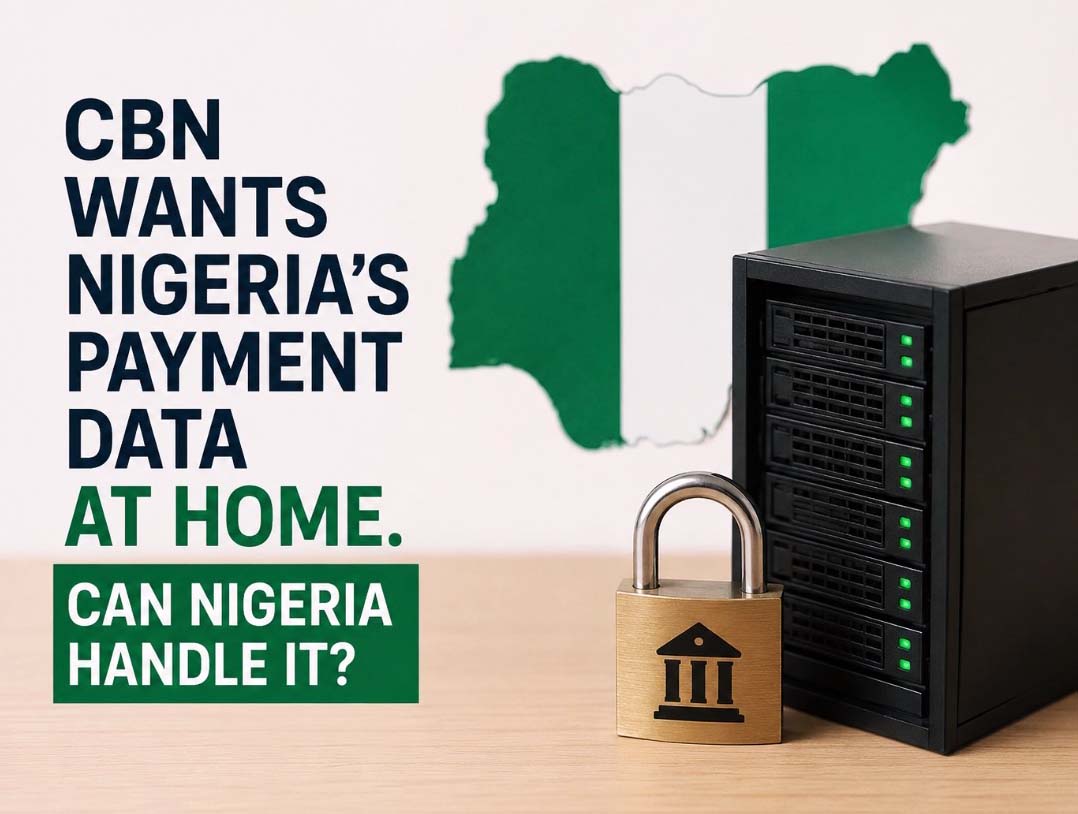
By Francisca Anuforo
The Central Bank of Nigeria (CBN) has directed banks, fintechs and other licensed payment operators to store and manage payment transaction data generated in Nigeria within the country, with full compliance required from January 1, 2027.
The directive, contained in a circular issued by the CBN’s Payments System Supervision Department on June 15, 2026, applies to deposit money banks, microfinance banks, mobile money operators, switching and processing companies, payment terminal service providers, payment solution service providers, super agents and other licensed operators in the Nigerian payments ecosystem.
The data localisation requirement is part of a broader set of measures introduced by the apex bank to address market concentration, operational dependence, systemic importance and ownership transparency within Nigeria’s rapidly expanding payments ecosystem.
While the policy is aimed at strengthening Nigeria’s control over critical financial data, it is also raising questions about the infrastructure required to support the transition.
The infrastructure question
For years, Nigerian banks and fintech companies have relied heavily on cloud infrastructure and data centres to run digital payment services.
Moving payment transaction data into Nigeria is therefore not necessarily a simple change of storage location. For some operators, compliance could require changes to how databases, applications, backups and disaster-recovery systems are deployed.
The availability of local infrastructure is consequently becoming an important part of the conversation around the January 2027 deadline.
There are already significant data-centre investments in Nigeria, and industry operators have pushed back against concerns that the country lacks the capacity to support the transition.
Ayotunde Coker, Chief Executive Officer of Open Access Data Centres, said in July that Nigeria has sufficient high-quality data-centre capacity and that operators should proceed with their compliance plans rather than delay because of infrastructure concerns. He also pointed to expanding investments in the sector.
Other industry observers, however, have raised questions about whether available capacity can support the specific requirements of mission-critical financial workloads at scale.
That distinction is important.
Having physical data-centre space does not automatically mean having all the cloud computing, storage, networking, redundancy and disaster-recovery capabilities required to move large financial systems without disrupting services.
What happens to fintechs?
The impact of the directive could also differ significantly between large banks and smaller fintechs.
Large financial institutions generally have established technology teams, data centres and infrastructure budgets. Smaller fintechs may rely more heavily on cloud platforms and managed services, allowing them to scale without owning large amounts of physical infrastructure.
A major migration could therefore require some operators to invest more heavily in local hosting, infrastructure, security and technical personnel.
Industry analysts have already warned that the transition could stretch operators and require significant system changes ahead of the deadline.
At the same time, the directive could create opportunities for Nigeria’s domestic data-centre and cloud-computing industry.
The CBN’s policy has already been linked to expectations of increased demand for local data centres, cloud services and other digital infrastructure.
What about the major cloud providers?
Another issue is Nigeria’s relationship with global cloud providers.
AWS, Microsoft Azure and Google Cloud have played major roles in powering technology businesses globally. AWS, for example, operates a Lagos Local Zone, while its broader Africa region is based in Cape Town. AWS has also highlighted its Local Zones and other sovereignty-related solutions in discussions around Nigeria’s financial-services sector.
This means the question for financial institutions is not simply whether data can be physically stored in Nigeria.
They also have to determine whether the local infrastructure available to them can provide the computing, database, security, resilience and recovery capabilities their operations require.
A potential boost for Nigeria’s digital infrastructure
Despite the concerns, the policy could have a significant long-term benefit.
If financial institutions increase their demand for local data-centre capacity, cloud services, cybersecurity and related infrastructure, Nigeria could see more investment in the domestic digital infrastructure ecosystem.
The CBN’s directive therefore goes beyond where payment records are stored.
It could influence where banks and fintechs build infrastructure, which cloud services they use and how much they invest in local technology.
The policy could also strengthen Nigeria’s data sovereignty by giving regulators greater domestic access to critical payment information.
But achieving that objective will depend heavily on execution.
With January 1, 2027 approaching, banks and fintechs have a limited window to assess their infrastructure, identify data covered by the directive and determine how their existing systems will comply.
For consumers, the biggest concern is ultimately simple: will the transition happen without affecting the reliability of the digital payment services they depend on every day?
Nigeria wants its payment data at home.
The next test is whether the country’s digital infrastructure is ready to accommodate it.