
 Digitnomics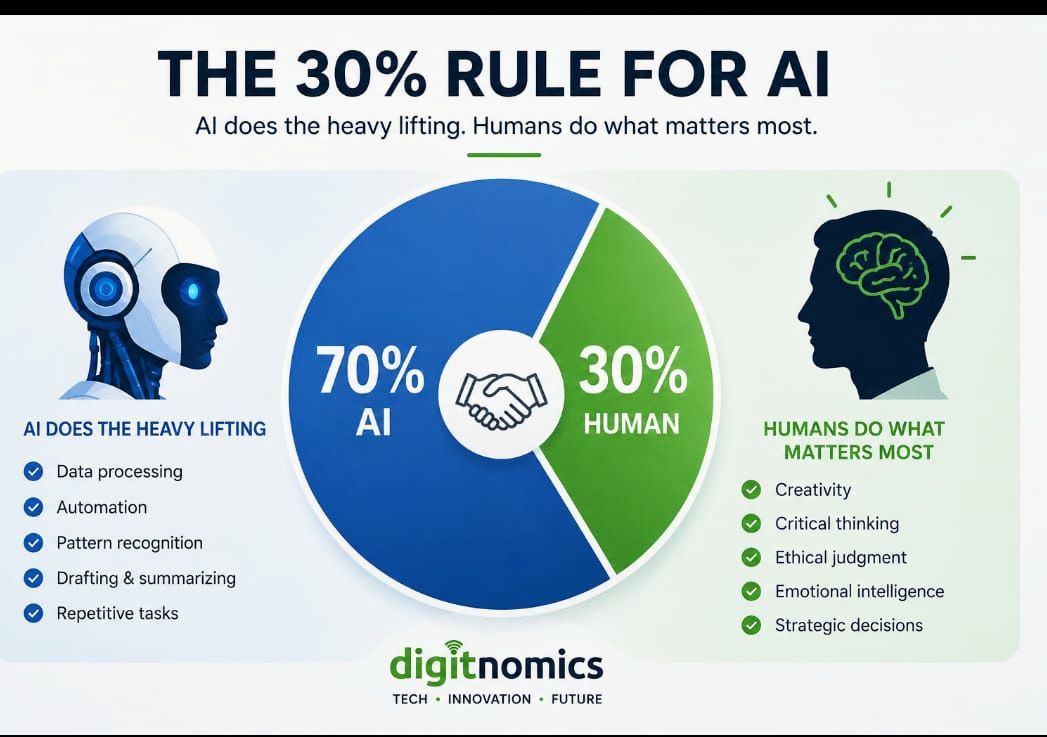
By Digitnomics
As artificial intelligence continues to take on more tasks across the workplace, a new approach to AI adoption is gaining attention: the “30% rule”.
The concept proposes a 70/30 division of labour, where artificial intelligence handles about 70 per cent of routine or time-consuming work, while humans retain the remaining 30 per cent for responsibilities that require creativity, critical thinking, judgement and emotional intelligence.
The idea comes as businesses and workers grapple with the rapid expansion of generative AI and growing concerns about what increasing automation could mean for employment.
Rather than treating AI as a complete replacement for human workers, the 30% rule promotes a hybrid model in which machines handle the heavy lifting while people remain responsible for decisions where human judgement matters most.
What does the 30% rule mean?
The 30% rule is not a formal law or universally accepted industry standard. Instead, it is an emerging workplace framework for thinking about how humans and AI can share responsibilities.
Under the model, AI could be used to handle repetitive tasks such as analysing large amounts of data, generating first drafts, summarising documents, processing information or carrying out other time-intensive activities.
Humans would then focus on areas where machines have limitations, including strategic decision-making, ethical judgement, creativity, relationship management and understanding complex social or business contexts.
The exact 70/30 split does not necessarily have to apply to every job.
For some roles, AI could handle significantly more than 70 per cent of routine tasks. In others, human involvement may need to remain much higher because of the sensitivity or complexity of the work.
The bigger principle is about maintaining a meaningful human role even as automation expands.
Why is the idea gaining attention?
The rapid adoption of generative AI has created both excitement and uncertainty in workplaces.
AI tools can perform certain tasks in seconds that previously required hours of human effort. This has encouraged organisations to explore automation as a way to improve productivity and reduce costs.
At the same time, workers are increasingly questioning how much of their jobs could eventually be automated.
The concern is particularly significant in industries where employees spend substantial amounts of time on repetitive digital tasks.
The 30% approach attempts to address this tension by positioning AI as an assistant rather than an outright replacement for human talent.
AI can do the heavy lifting, but humans make the call
One of the strongest arguments for the model is that AI can process information quickly, but speed does not automatically translate into sound judgement.
An AI system may generate a report, identify patterns in data or produce a recommendation. A human still needs to determine whether the information is accurate, appropriate and relevant to the situation.
This becomes particularly important when decisions involve ethics, customers, employees, financial consequences or sensitive information.
Human oversight can also help identify AI-generated errors, misleading information and situations where an automated recommendation does not adequately reflect the real-world context.
What could this mean for Nigerian businesses?
For Nigerian organisations adopting AI, the 30% rule offers a useful way to think about automation without assuming that every task should be handed over to a machine.
A business could use AI to automate administrative work, analyse customer feedback, prepare reports, assist with content production or process large datasets, while employees remain responsible for reviewing outputs and making important decisions.
This could allow businesses to improve productivity while preserving the human skills that remain critical to customer service, leadership and innovation.
For workers, the shift also highlights the importance of developing skills that complement AI rather than competing directly with it.
Critical thinking, communication, creativity, problem-solving and the ability to work effectively with AI tools are likely to become increasingly valuable.
The real question may not be 70/30
The biggest lesson from the 30% rule may not be the exact percentage.
Instead, it is the principle behind it: AI should increase human capability rather than eliminate human responsibility.
As companies continue to integrate AI into everyday operations, the most effective workplaces may be those that understand what machines do best and what humans do best.
The future of work, therefore, may not simply be about humans versus AI.
It could increasingly be about how well the two work together.