
Telcos seek regulatory clarity on airtime, data credit after court affirms FCCPC, NCC oversight
 Digitnomics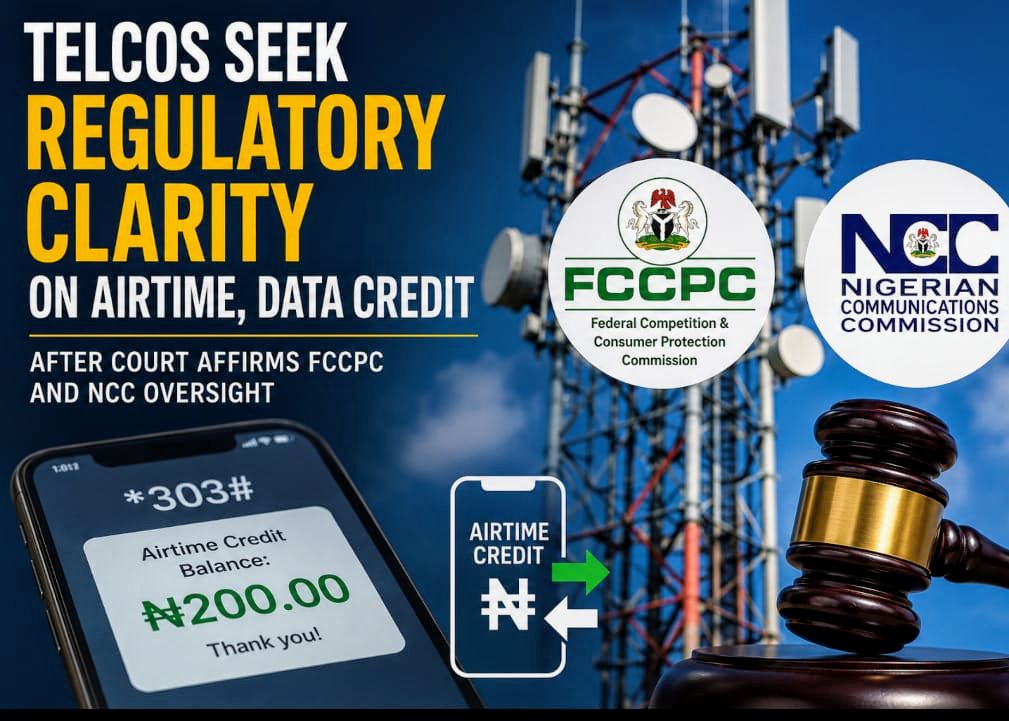
Nigeria’s telecommunications operators have called for a clear regulatory framework to govern airtime and data credit services following a Federal High Court ruling that affirmed the oversight roles of both the Nigerian Communications Commission (NCC) and the Federal Competition and Consumer Protection Commission (FCCPC).
The Association of Licensed Telecommunications Operators of Nigeria (ALTON) said the judgment provides legal clarity on the powers of both regulators but also highlights the urgent need for a coordinated approach to prevent regulatory uncertainty that could disrupt services relied upon by millions of Nigerians.
Speaking on behalf of the association, ALTON Chairman, Gbenga Adebayo, welcomed the court’s decision, noting that the industry now expects both agencies to establish a practical framework for collaboration.
“The court has confirmed the FCCPC’s authority while preserving the NCC’s regulatory mandate. The next step is for both regulators to develop a coordination framework that provides certainty for operators and consumers alike,” he said.
Court affirms concurrent powers
Justice Ambrose Lewis-Allagoa of the Federal High Court, in Suit No. FHC/L/CS/760/2026, ruled that the FCCPC and NCC have concurrent authority over airtime and data credit services.
According to the judgment, the FCCPC retains its powers under the Federal Competition and Consumer Protection Act 2018, while the NCC remains the exclusive regulator of telecommunications licensing, technical standards and sector-specific regulation under the Nigerian Communications Act 2003.
The court emphasized that the two agencies are expected to work together rather than operate in conflict, stating that “concurrency means coexistence, not displacement.”
Why operators are concerned
ALTON said the industry has already experienced the consequences of regulatory uncertainty.
Earlier this year, airtime and data credit services were suspended for about three months following regulatory enforcement actions, temporarily denying millions of subscribers access to emergency airtime and data borrowing services.
For many Nigerians, particularly small business owners and individuals who rely on borrowed airtime or data to stay connected until their next recharge, the suspension created significant challenges.
Industry stakeholders estimate that more than 40 million subscribers use airtime and data credit services across the country.
According to ALTON, the experience underscored the importance of predictable regulation and clear communication between regulators before enforcement actions are implemented.
Call for stakeholder engagement
The association urged both regulators to institutionalise stakeholder consultations before introducing policies or enforcement measures that could significantly affect the telecommunications industry.
Adebayo also referenced the Presidential Enabling Business Environment Council (PEBEC) directive issued on April 6, 2026, which requires federal agencies to conduct Regulatory Impact Assessments (RIAs) before implementing major regulatory changes.
He said compliance with the directive would help improve transparency, reduce regulatory conflicts and minimise unintended disruptions to consumers and businesses.
Need for a practical framework
While the court has clarified that both agencies have legitimate roles, industry operators say it does not spell out how the regulators should coordinate their responsibilities in practice.
Questions remain over which agency should take the lead on specific regulatory decisions, how disputes between regulators should be resolved, and what consultation processes should precede enforcement actions.
ALTON believes addressing these issues through a formal coordination framework will strengthen regulatory certainty, protect consumers and create a more stable operating environment for telecommunications operators.
As Nigeria’s digital economy continues to expand, stakeholders say effective collaboration between regulators will be essential to ensuring innovation, consumer protection and uninterrupted access to critical telecommunications services.
Follow Digitnomics for credible updates and in-depth analysis on technology, telecoms, business and the digital economy.